
Information Obesity
Staying Lean Brings Calm and Efficiency

Your brain and body, as you read this, are in a certain state of being. If you could measure every physiological process within your body, you could take a data-based snapshot of this moment. Your equilibrium, or homeostasis, is unique to this moment. Hormones, neurotransmitters, body temperature, gut microbiome - the whole you.
Some memories, emotions, sensations - including what you read - from your day-to-day will remain with you for weeks, months, or years - others will fall away immediately.
Perhaps some of it is stored in the recesses of your mind and will resurface at some point in the future, but for the most part, if it doesn’t strike you immediately, it’s lost forever.
This is not a bug, it’s a feature. If you could remember everything, would you really enjoy it?
Seems like it would be overwhelming.
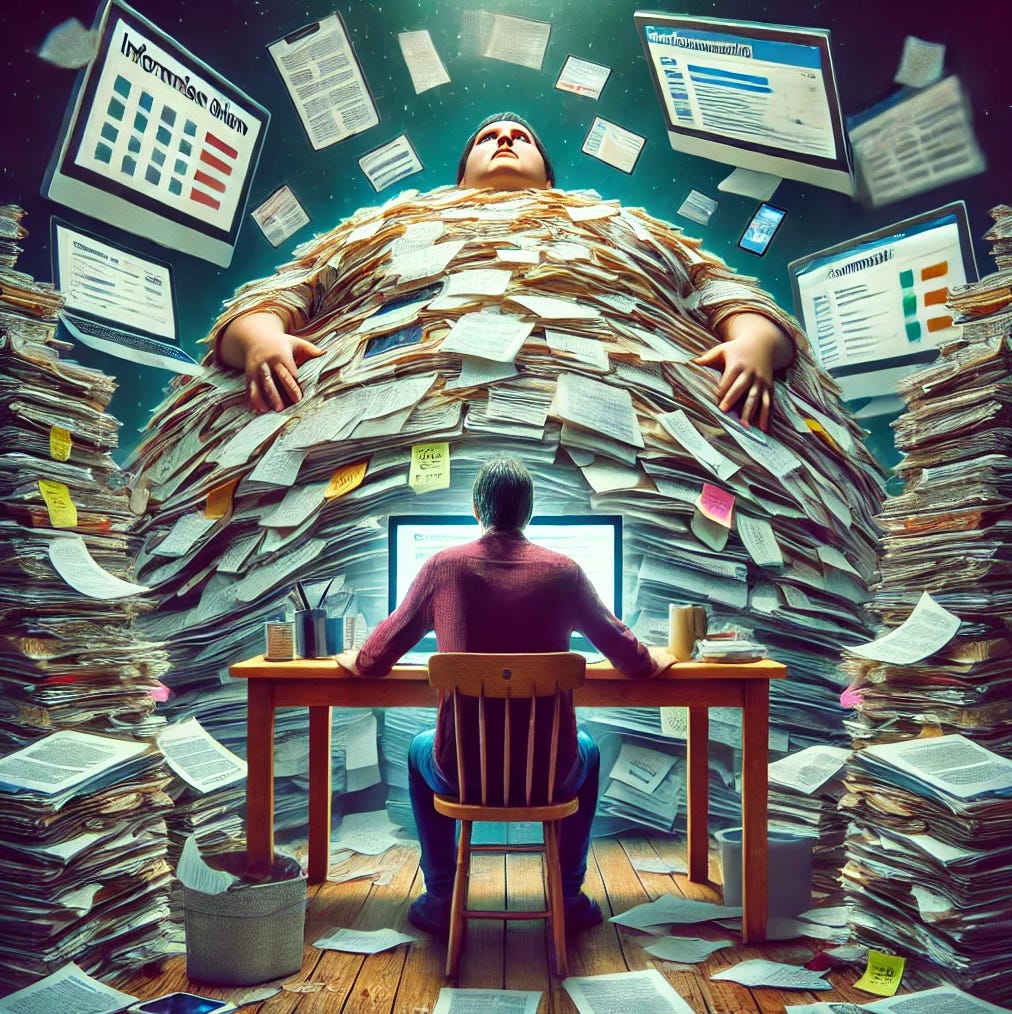
Everything you read, see, learn, or feel will pass through you all the time - and some of it will stick.
The problem is (especially in materialistic, Western countries) - we want to keep everything.
I love this video (bookmarked for later).
This article isn’t relevant to me at the moment (but it could be one day, I must save it).
This firework show is incredible, I am going to record is on my phone so that I can show my friends and enjoy it later this year (never happens).
Part of the reason that you want to save too much, is that too much is being thrown at you. Without a system with which to process information, you default to the easiest or most convenient (bookmark, screenshot).
You could use a Zettelkaten, or design your own system using the Codex. If you want to expand your working memory, you could even use a memory palace. But, unless you are an academic - there may be a better option: don’t save anything at all.
Your brain defaults to this option naturally. Of the dozens gigabytes of information your sensory perceptions are taking in every minute (most of it visual), what’s actually being passed to your brain is mere megabytes.
The brain, to conserve energy, is engaging in a predictive process based on past information, then confirming it with information coming in through the senses. What does not meet the expectation is adjusted. Ever do a double take? This is why.
For reasons unknown (your state at this time), your brain will choose to hold onto specific, seemingly random things. That art piece that made you feel something. The way the sun bounced off your child’s hair at sunrise. That one passage on that one page of that one book.
Hold onto what sticks. Don’t overthink why it sticks.
Explore it, indulge in it, think about it - and don’t worry about what doesn’t stick. What does stick fits with you for some purpose that can only be explained by who you are RIGHT NOW. It effortlessly becomes part of you.
This is where our obesity metaphor comes in: eat excess food, store some as fat. Eat less than required, lose some fat due to your body requiring those stored resources.
If you eat too much excess and store too much fat, your body will begin to have dysregulation in other systems, like your endocrine system. The endocrine system disruption could affect sleep and digestion - which can exacerbate your weight gain (this would be a positive feedback loop).
What if, in a perfectly functioning body, you ate the amount appropriate for your activities. Your body would then take what is necessary for its maintenance and repair. The non-essential matter would then be excreted.
What if you treated your mental intake the same way? Social media browsing, news consumption, article selection, movie choice? What if you only took in the minimum, as close to what you needed right now as possible?
If you are an avid reader, you may notice that fiction reading is easy in this regard because it creates imagery in your mind. Non-fiction is harder because it doesn’t - but some things will create that imagery or strong emotion anyway because it just FITS. It fits RIGHT NOW.
If it doesn’t fit, do you take notes and desperately try to cram it into your mind for later (just-in-case-I-need-it) use?
Carrying the burden of a million bookmarks, items on our “to-watch” list, or “to-read” list, or even to-do list is invading our experience of the present moment. It is interrupting who we are right now. We are not able to experience the present because we are drawing our experience from a repository of notes and action items.
If you need something from non-fiction, trust that in your curiosity and winding path of life, you will find it when you need it. If you don’t hold onto something, it’s irrelevant to you - it’s excess baggage your mind and body doesn’t want or need to carry. It’s stored as fat.
If you enjoy fiction, read fiction. If you enjoy non-fiction, read non-fiction. When you don’t enjoy a book, put it down and stop thinking about it. If you MUST read something (for school or work), find the enjoyable within it. Look for the interesting. This will help you retain it effortlessly. It must become a part of you! Dare I say - it must be digested.
Side note: the purpose of notes or writing things down is not to have it as reference for later - it is a way of digesting the information now. Writing is an extension of thinking.
Stop adding movies to your watchlist. Stop adding items to a wish list. If you want something in the moment - if you need something - if it makes sense.. Do it. If it doesn’t, move on.
The Smaller Picture: Stop saving bookmarks and screenshots - if it doesn’t stick without a note, it’s not meant for you right now. If it is meant for you, you will find it again.
I hope you got some value out of this and, as always, thanks for reading.
Oliver